PM Modi Inaugurates Grand International Exposition of Sacred Piprahwa Relics Related to Lord Buddha
- Anjali Regmi
- Jan 4
- 5 min read

The dawn of 2026 has brought a moment of immense spiritual and national pride for India. On January 3, 2026, Prime Minister Narendra Modi inaugurated a landmark event that has been over a century in the making. The Grand International Exposition, titled "The Light and the Lotus: Relics of the Awakened One," opened its doors at the Rai Pithora Cultural Complex in New Delhi. This is not just another museum display; it is a historic reunification of sacred treasures that define the very soul of India’s Buddhist heritage.
The exposition centers around the legendary Piprahwa relics, which are among the earliest and most historically significant remains directly connected to Lord Buddha. For the first time in 125 years, the scattered pieces of this sacred history have come back together on Indian soil. As the Prime Minister noted during the event, this is a moment where the nation’s treasured legacy has finally returned home, marking a new chapter in India’s cultural and spiritual journey.
The Significance of the Piprahwa Relics
To understand why this event is so important, we have to look back at the history of the Piprahwa site. Located in the Siddharthnagar district of Uttar Pradesh, Piprahwa is widely believed by archaeologists and historians to be the ancient city of Kapilavastu. This is the place where Prince Siddhartha spent his early years before he set out on the path to becoming the Buddha.
The relics themselves were first discovered in 1898 by a British engineer named William Claxton Peppé. During an excavation of a massive stupa, he found a sandstone coffer containing soapstone caskets. Inside these caskets were bone fragments, ashes, and a stunning collection of over 1,800 precious gems, including rubies, pearls, and gold ornaments. An inscription in ancient Brahmi script on one of the caskets clearly stated that these were the remains of the Buddha, enshrined by his own Shakya clan. This discovery provided crucial historical evidence of the Buddha’s life and the traditions that followed his passing.
A Historic Homecoming After 127 Years
After their discovery in the late 19th century, the relics were divided. Some were gifted to the King of Siam (modern-day Thailand), some remained in Indian museums, and a significant portion was taken to England by the Peppé family. For more than a century, these "gem relics" and reliquaries remained outside of India, often held in private collections.
The turning point came in July 2025. Through a successful public-private partnership and decisive government intervention, India managed to halt a planned auction at Sotheby’s and repatriated these sacred items. The exposition inaugurated by PM Modi marks the first time since 1898 that the repatriated gems have been reunited with the bone relics and artifacts preserved in the National Museum in New Delhi and the Indian Museum in Kolkata. This reunification is a powerful symbol of India reclaiming its cultural identity and honoring its role as the birthplace of Buddha Dhamma.
Walking Through the Light and the Lotus
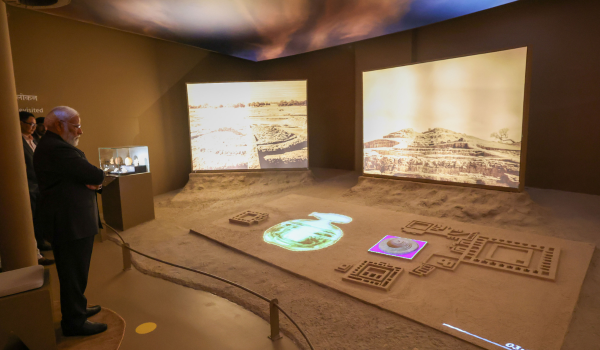
The exposition itself is a masterpiece of curation. Titled "The Light and the Lotus," it takes visitors on a sensory and spiritual journey. The Prime Minister spent time walking through the exhibition, which features over 80 exceptional objects dating from the 6th century BCE to the modern day. The display is not just about old stones; it includes intricate sculptures, ancient manuscripts, thangkas, and ritual objects that show how Buddhist art and thought spread across the world.
At the heart of the exhibition is a stunning model inspired by the Sanchi Stupa. This central piece serves as the focal point where the authentic relics and the repatriated gems are brought together. The use of modern technology like digital reconstructions, projections, and films helps bridge the gap between the ancient past and the present. It allows visitors to visualize the journey of the relics—from their original enshrinement to their discovery and their eventual return home.
PM Modi on the Timeless Wisdom of Buddha
During the inauguration, Prime Minister Modi spoke passionately about the relevance of Lord Buddha in today’s world. He remarked that the wisdom of the Buddha is not confined to any specific era; it is timeless and belongs to all of humanity. He emphasized that the beginning of 2026 being marked by such a joyous and spiritual festival is deeply inspiring.
The Prime Minister also touched upon a deeper point about national heritage. He stated that slavery and colonial rule do not just exploit a nation economically or politically; they erode its heritage. By bringing these relics back, India is healing those old wounds and reconnecting with its glorious history. He praised the efforts of the Ministry of Culture and all the partners involved in the repatriation, noting that these artifacts are an inseparable part of the Indian society and soul.
Connecting the Youth with Cultural Roots
One of the primary goals of this grand exposition is to bridge the gap between India’s ancient wisdom and its modern youth. PM Modi exhorted the younger generation to visit the Rai Pithora Cultural Complex and experience this heritage firsthand. In a world that is moving faster than ever, the teachings of peace, compassion, and mindfulness offered by Buddhism provide a much-needed anchor.
The exposition is organized into several thematic sections, such as "Piprahwa Revisited" and "Expansion of Buddhist Art and Ideals Beyond Borders." These sections explain the history in simple terms, making it accessible to students and scholars alike. By showcasing the physical proof of India’s spiritual history, the government aims to instill a sense of pride and curiosity in the youth about their own roots.
India as the Global Guardian of Heritage
This event also sends a strong message to the international community. By successfully repatriating the Piprahwa relics and hosting a world-class exposition, India is asserting its role as the global custodian of Buddhist heritage. In recent years, India has shared its sacred relics for public veneration in countries like Thailand and Vietnam, strengthening diplomatic and spiritual bonds.
The "Light and the Lotus" exhibition reinforces the idea that India is not just a protector of the past but a living carrier of the tradition. It shows that the values of the Buddha—non-violence and universal brotherhood—are the pillars upon which modern India seeks to build its future. The return of these relics is seen as a victory for cultural diplomacy and a testament to the country's growing soft power on the global stage.
Conclusion: A New Beginning in 2026
The inauguration of the Grand International Exposition of Sacred Piprahwa Relics is a landmark moment that blends history, spirituality, and national identity. As the first major public event of the year for the Prime Minister, it sets a tone of cultural revival and peace for 2026. For the thousands of pilgrims, historians, and tourists who will visit the exhibition, it offers a rare chance to stand in the presence of history that was nearly lost to the world.
The Piprahwa relics have finally finished their long journey. From the ancient stupas of Kapilavastu to the auction houses of the West, and finally back to a grand hall in the heart of Delhi, their story is one of resilience. This exposition ensures that the light of the Buddha continues to shine brightly, reminding us that while physical objects may be taken away, the spiritual legacy of a nation can never be truly extinguished.


Comments