The Cracks in the Citadel: The Sudden Exit of Rohini Acharya
- Anjali Regmi
- Nov 16, 2025
- 4 min read

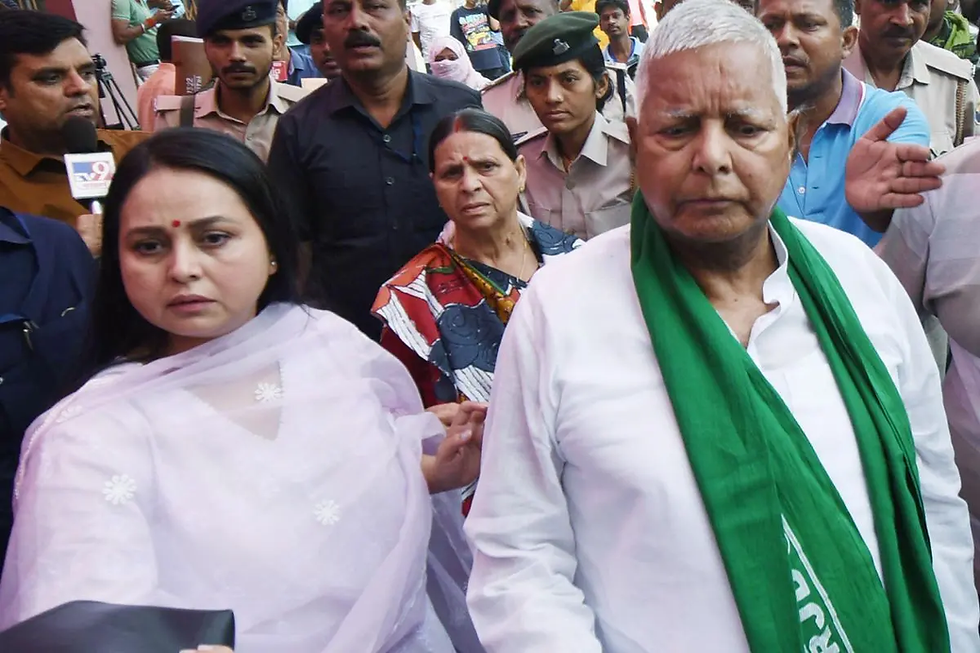
The political landscape of Bihar, already reeling from the crushing defeat of the Rashtriya Janata Dal (RJD) in the recent Assembly elections, has been hit by a shocking personal and political earthquake. Rohini Acharya, daughter of RJD patriarch Lalu Prasad Yadav, has not only announced her exit from active politics but has also publicly declared she is severing ties with her family. This dramatic, painful split has thrown a harsh light on the internal struggles, resentments, and power games simmering within one of India's most prominent political dynasties. The timing—just a day after the party suffered one of its steepest electoral setbacks—makes the announcement a moment of acute crisis for the RJD.
The Shock of the Defeat
The backdrop to this dramatic family fallout is the disastrous performance of the RJD led alliance in the Bihar polls. The party, which had secured a respectable number of seats in the last election and had high hopes this time, saw its tally drop drastically. This loss was not just an electoral setback; it was a profound blow to the party’s morale and the leadership’s image.
In politics, victory often smooths over differences, but defeat can expose every crack and weakness. The huge loss amplified questions about the party’s strategy, candidate selection, and the influence of various internal groups. When a political party is reduced to a fraction of its strength, the search for who is to blame starts immediately, and the pressure within the inner circle becomes immense. It seems that this intense pressure cooker environment is what ultimately led to Rohini Acharya's sudden and highly public break. Her statement, in which she took "all the blame," was less an admission of guilt and more a fierce statement about where she believes the real problems lie.
The Allegations Against Inner Circle Aides
The most striking part of Rohini Acharya's public statement was her direct naming of specific individuals, namely Tejashwi Yadav’s close aide, Sanjay Yadav, and another individual, Rameez. She explicitly stated that they had asked her to quit politics and disown her family. This is a very serious allegation that suggests an intense power struggle operating right at the heart of the party's leadership structure.
For an influential family member to single out and blame a brother's close confidantes in such a public manner suggests a deep-seated frustration. It paints a picture of a palace intrigue, where those closest to the primary leader—her brother Tejashwi Yadav—were allegedly manipulating the political landscape and creating distance between the family members. These aides are often referred to as "Chanakyas," or political strategists, but in the aftermath of a major loss, they often become the first target of blame for a frustrated rank and file. Rohini's outburst strongly suggests that the influence of these non-family figures had become a source of major resentment within the Yadav household, eroding trust and causing internal conflicts.
The Family Divide: A History of Fissures
Rohini Acharya’s exit is not an isolated event; it is the most recent and arguably most painful sign of a widening split within the Yadav family. This is a family that has seen its share of public differences before. Her elder brother, Tej Pratap Yadav, has also been involved in controversies, leading to him being distanced from both the party and the family.
The expulsion and distance of a key family member—regardless of the reason—creates fissures. These cracks in the foundation weaken the sense of unity that is vital for a family-run political party. Rohini, a doctor by qualification who lives with her husband in Singapore, had gained immense public respect for her act of donating a kidney to her father, Lalu Prasad Yadav. This personal sacrifice highlighted her deep commitment and loyalty to her father, making her current decision to sever ties all the more devastating and unbelievable for the public. Her loyalty, seemingly, could not extend to the political and personal climate she felt forced out of.
The Role of an Outsider Looking In
Rohini Acharya's role in the party was unique. She was not a full-time, ground-level politician, yet she was an influential figure, particularly through social media, and she had contested the Lok Sabha election. She often acted as a vocal defender of her family and the party’s ideology. Her physical distance, being based in Singapore, might have given her an outsider's perspective, allowing her to see the party's internal dynamics perhaps more clearly than those immersed in the daily political grind in Patna.
When she returned to campaign for her brother and the party, she was actively involved. Her sudden turn from dedicated campaigner to family critic after the election suggests that her involvement brought her face-to-face with an internal reality she found unacceptable or hurtful. The fact that she took "all the blame" could be interpreted as a bitter protest. It is the action of someone who feels they have fulfilled their duty—as a daughter, sister, and party worker—only to be humiliated or pushed away when it was time to address the reasons for the failure. Her emotional post and subsequent comments about being abused and "thrown out" underscore the pain and betrayal she must have felt.
The Impact on the RJD and Bihar Politics
The departure of Rohini Acharya at this moment will undoubtedly have a significant impact on the RJD. The party is already struggling to cope with a major electoral loss and is facing intense scrutiny over its leadership. The public nature of this family feud adds another layer of drama and instability. For a party built heavily around the charisma and family legacy of Lalu Prasad Yadav, seeing a key member publicly denounce the family structure weakens its image of internal solidarity.
It gives political opponents an easy talking point: if the family cannot stay united, how can they run a state? This public fracturing can erode the confidence of the party’s core voters and cadres, who often look to the family for a clear and unified direction. The RJD now has the twin tasks of analyzing the reasons for its election defeat while simultaneously trying to manage a dramatic and very public family crisis that threatens to define the narrative around its leadership. The entire episode highlights the intense pressure, the high stakes, and the personal cost of being part of a political dynasty in a highly competitive state like Bihar. It is a moment of reckoning for the RJD, forcing them to look closely at the influences and internal workings that are tearing at the very fabric of the Yadav family.


Comments