The New Era of Indian Diplomacy: Closing the US Trade Deal
- Anjali Regmi
- 3 days ago
- 4 min read

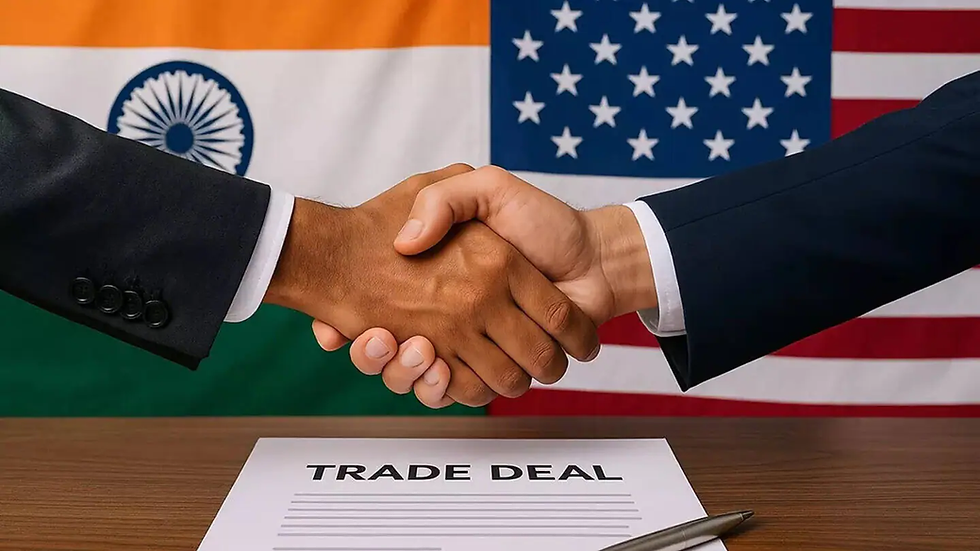
India is currently standing at a very interesting crossroads in global trade. For years, we heard about trade talks that seemed to go on forever without reaching a finish line. However, the tone has changed recently. Union Commerce and Industry Minister Piyush Goyal has signaled a significant shift, suggesting that the long-anticipated trade deal with the United States is finally moving towards closure.
This isn’t just about signing a piece of paper. It represents a fundamental change in how the Modi government handles international negotiations. Coming fresh off the heels of a massive deal with the European Union, the government is now applying a tried-and-tested strategy to finalize terms with Washington.
Moving Past the Sticky Issues
One of the most encouraging updates from Minister Goyal is the statement that there are no "sticky issues" left to be resolved. In the world of high-stakes trade, "sticky issues" are those stubborn points of disagreement—like tariffs on specific goods, dairy market access, or intellectual property rules—that usually keep negotiators awake at night for years.
The fact that these hurdles have been smoothed out suggests that both India and the US have found a middle ground that respects each other’s sensitivities. While the process has seen its fair share of delays, particularly with the 50% tariff imposition seen in late 2025, the underlying dialogue has remained friendly and professional.
Negotiating for the Future, Not the Present
One of the most fascinating insights Goyal shared is about the "Modi Method" of negotiation. In the past, India often negotiated based on where its economy stood at that exact moment. If the economy was $2 trillion, the deal reflected a $2 trillion capability.
Today, the approach is different. The government is not negotiating for the India of 2026. They are negotiating for the India of 2047—a projected $30 trillion economy. By presenting India as a future economic superpower rather than just a current market, the negotiators are able to command more respect and better terms. This forward-looking stance is what attracts global partners who want a stake in India’s long-term growth story.
The Policy of No Deadlines
You might wonder why we don’t have an exact date for the signing. This is intentional. The Modi government has adopted a strict "no artificial deadlines" policy. Minister Goyal explained that when you set a hard deadline, you often end up compromising just to meet it.
Instead, the Indian team waits until every single detail is beneficial for the country. Whether it’s protecting the interests of farmers or ensuring our small-scale industries aren’t overwhelmed, the deal is only signed when it is "win-win." As Goyal puts it, the date will be announced only when both sides are fully satisfied with the outcome.
Protecting Local Interests First
A recurring theme in the government’s trade strategy is the protection of domestic stakeholders. Every time a deal with a giant like the US or the EU is discussed, there is natural concern among local dairy farmers, fishermen, and small business owners.
The current negotiation strategy involves a multi-layered consultation process. The government works closely with export promotion councils and state-level chambers of commerce. The goal is to ensure that while we open up new markets for Indian textiles and services, we don't leave our most vulnerable sectors exposed to unfair competition.
Lessons from the Mother of All Deals
The recent success with the European Union (EU) has provided a blueprint for the US deal. The EU agreement was a landmark moment because it showed that India can successfully navigate the complex regulations of developed markets.
However, Goyal is quick to point out that India does not use a "one size fits all" template. What worked with Europe might not work with America because every country has different needs. The US deal is being handled as its own unique project, focusing on the specific synergy between Indian talent and American technology.
Why 2047 is the Magic Number
The government’s ultimate goal is "Viksit Bharat" or a Developed India by 2047. To reach that goal, India needs to be integrated into the global supply chain. We cannot grow in isolation.
By securing deals with the US, UK, and EU, India is effectively creating a massive network of trade partners. These agreements are expected to bring in billions in investment and create millions of jobs in sectors like manufacturing, agritech, and logistics. The US deal is seen as a vital piece of this puzzle, given that the US remains one of India's largest trading partners.
The Strategic Value of Quality
A major part of the government’s pitch is a focus on quality. For years, the global market had certain perceptions about Indian goods. Prime Minister Modi has been a vocal advocate for "Zero Defect, Zero Effect" manufacturing for over a decade.
The logic being used in negotiations is simple: as demand from these trade deals increases, the quality of Indian products will naturally rise to meet international standards. If India can export $7 billion worth of a product today, the government believes that with the right trade framework, that number can easily jump to $70 billion.
Conclusion: A Position of Strength
The takeaway from Minister Goyal’s recent updates is clear: India is no longer a hesitant participant in global trade. We are now a confident negotiator that knows its worth. The "moving towards closure" status of the US deal is a sign that the world’s two largest democracies are finding a way to work together that benefits everyone.
By focusing on long-term goals rather than short-term gains, the Modi government is setting the stage for an India that is globally competitive and domestically secure. The final announcement might not have a countdown clock, but the progress behind the scenes suggests that a new era of prosperity is just around the corner.


Comments